Saturday, January 1, 2011

UMS students Sections 104 & 113, START HERE!

Photo taken from Digital Tools

Hello UMS students of Sections 104 and 113!

Click on the dates to browse the out-of-class materials and related websites


English for Academic Reading and Writing UB00402
Section 104 / Podium 1A
7.00-10.00 PM (Tuesdays)


---

Oral Communication in English UB00202
Section 113 / Podium C
7.00-10.00 PM (Wednesdays)

Wednesday, April 7, 2010

7 Apr - Final Exam (Oral Presentation)

Greetings!

I have decided that the most fair and smoothest format is the MUET-based speaking format. There will be two tasks; Task A and Task B.

Here is the standard instruction sample:


This is how the test will run tonight:
  1. Students will draw lots and be assigned to a new group of 4
  2. Groups will take turn to be assessed similar to MUET format
  3. The group can stay in class and watch their peers perform
  4. Tasks will take up 30 minutes
  5. Students may leave once they are assessed
Please come on time (7 PM) since there are 6 groups to be assessed in 3 hours. NO postponement is allowed. If you miss this test, you will NOT pass the course.

Remember that the most important thing in this test is this. Language is secondary. Use mind-map, QIQS, structure in your presentation and you will definitely earn decent point.

See you!

Thursday, April 1, 2010

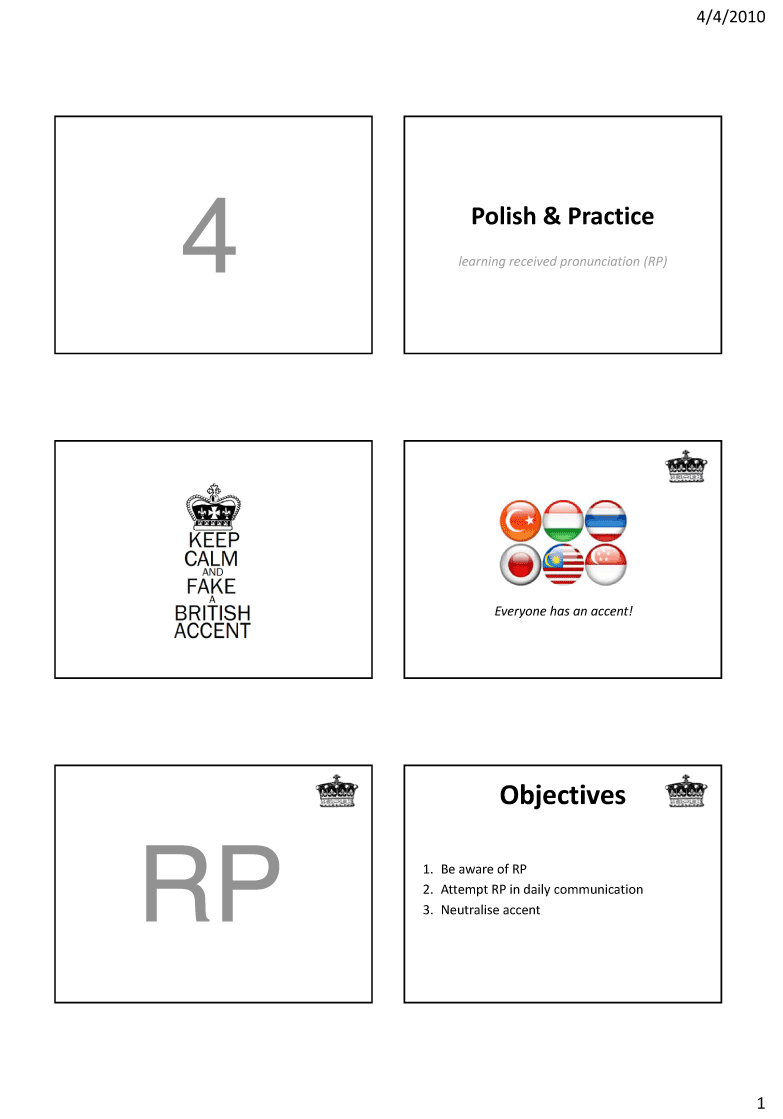
31 Mar - Tips, The Apprentice, Analysis of Best Speakers, Polish & Practice


Hello girls and boys,

No. 3 (Analysis of Best Speakers) and 4 (Polish and Practice) are the continuation of our class on 31 March. Follow the sequence of this virtual class and its simple instructions.

 
 1.  Concise Tips and Tricks
  • Study the slides
  • Summary (click image to enlarge)

---
2.  Communicative Game (The Apprentice)

---
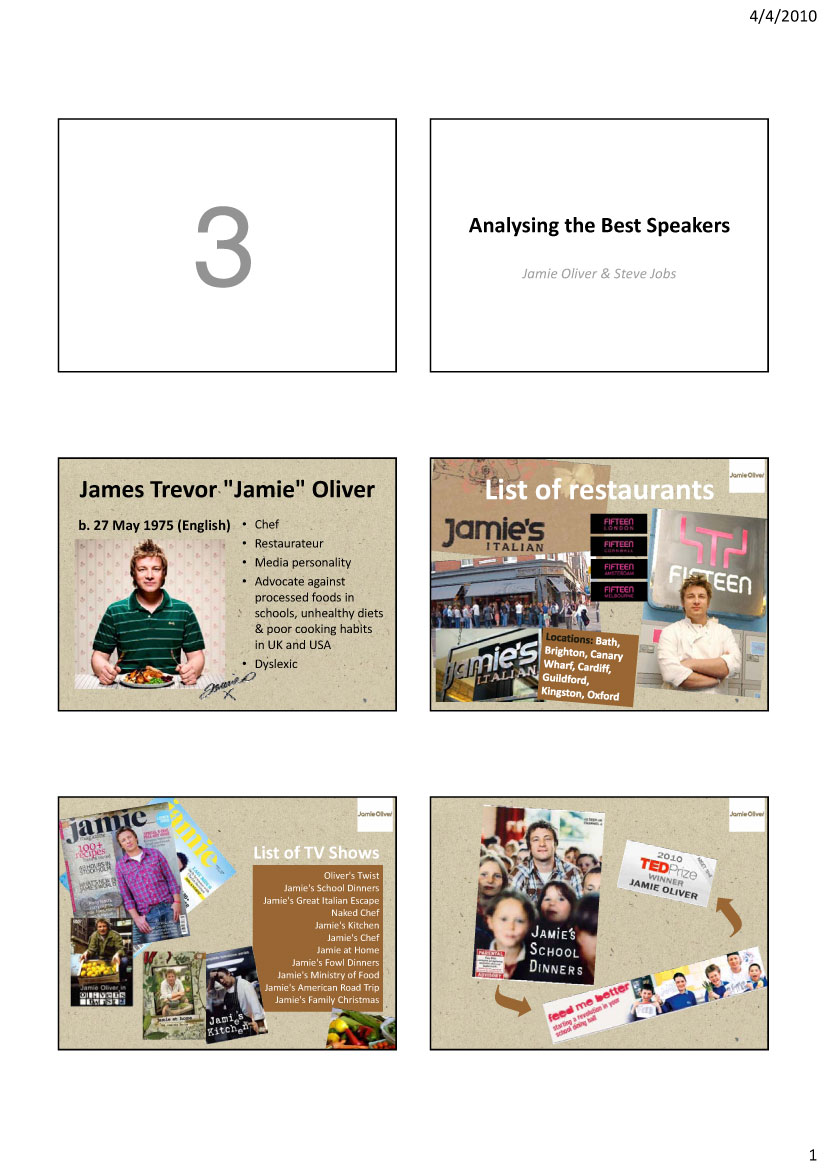
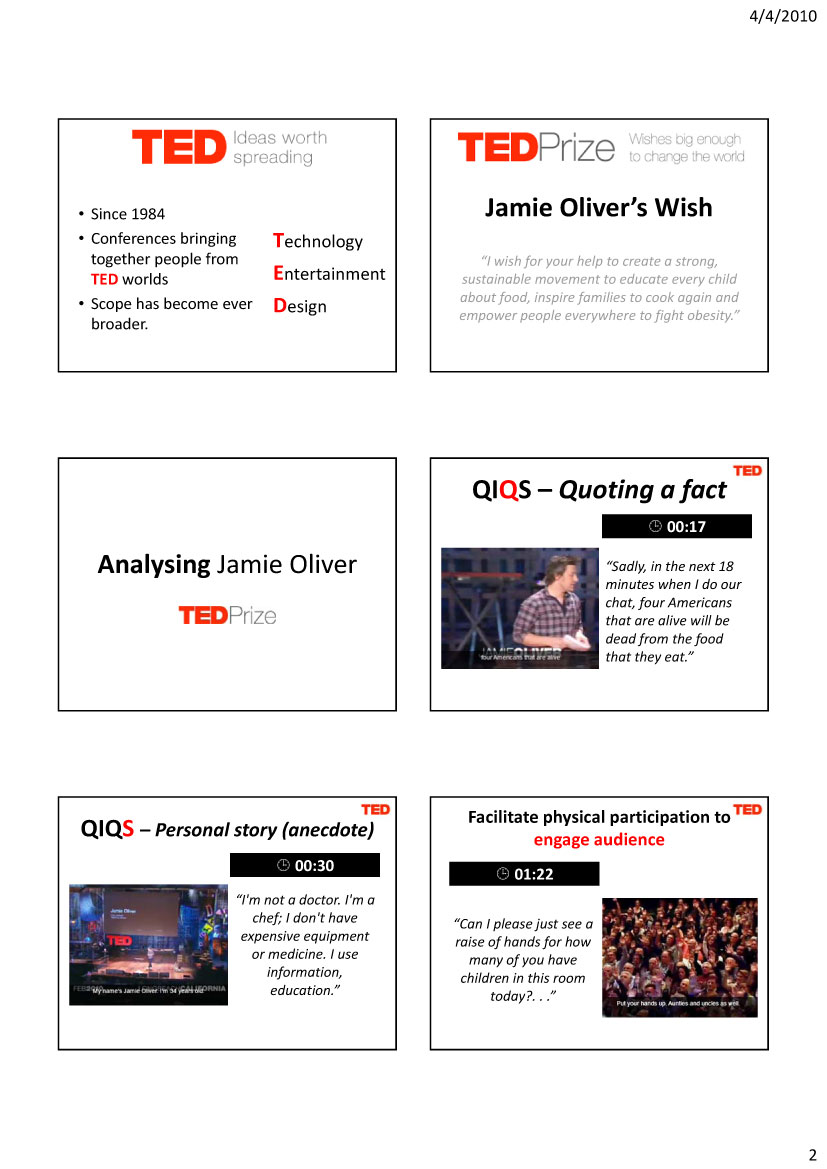
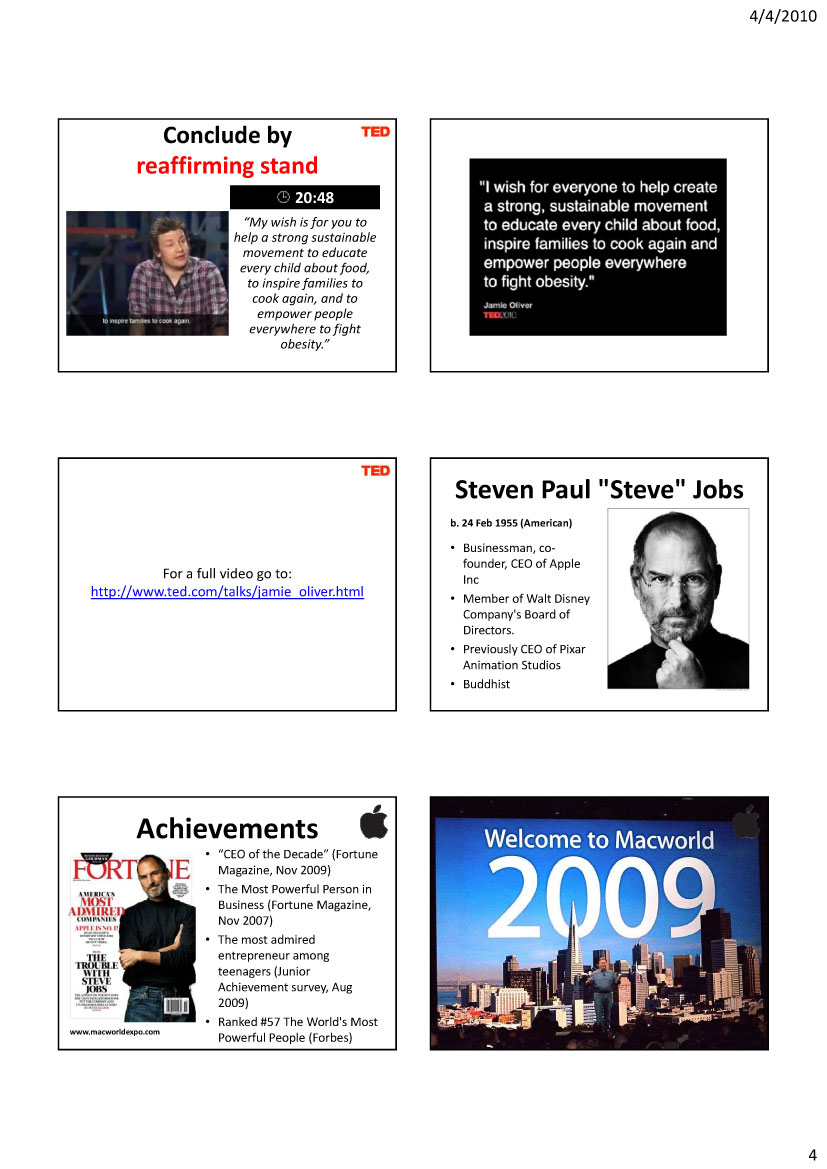
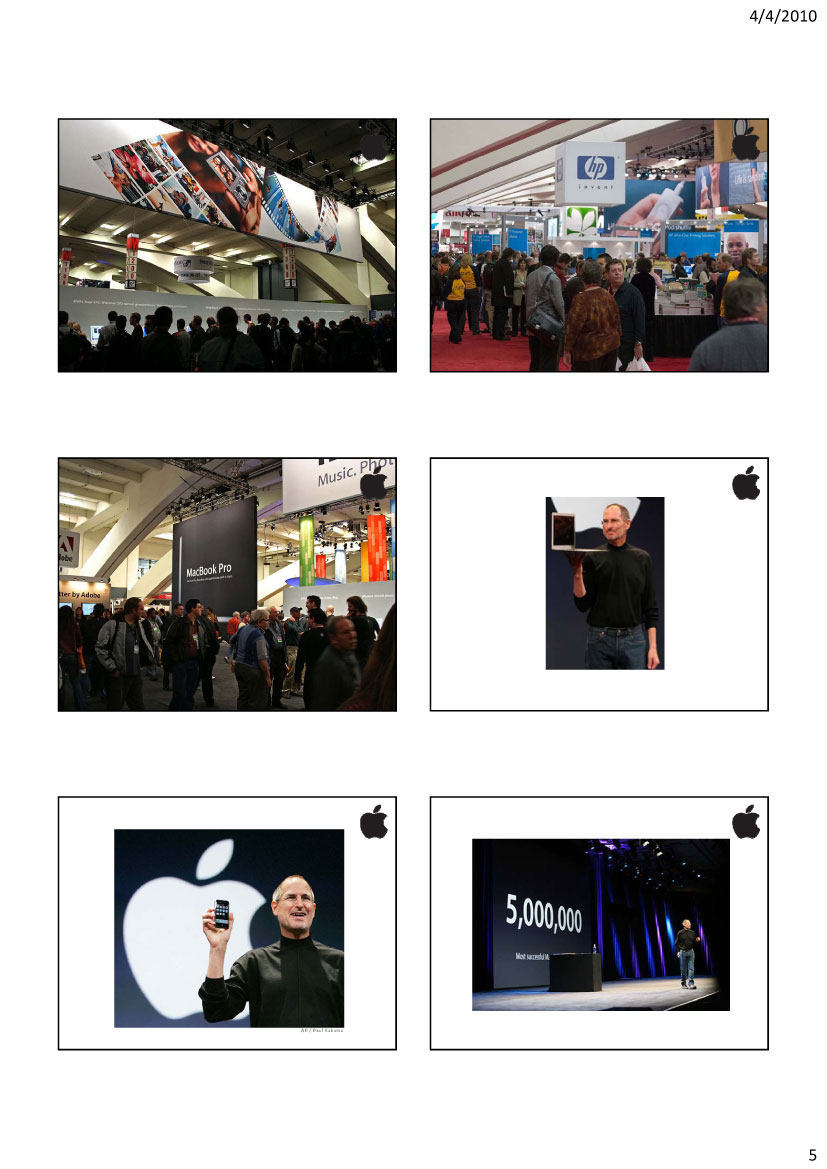
3.  Analysis of Best Speakers
  1. Slide 1-6
  2. Slide 7-12
  3. Slide 13-18
  4. Slide 19-24
  5. Slide 25-30
  6. Slide 31-32 
  • Watch Jamie Oliver's TED Prize Presentation at TED.com.
  • Use slides 9-21 above to guide your analysis.
  • Click the image below to enlarge instruction for TED.com video presentations.
  • Alternatively, you can also watch his presentation at YouTube.


  • Next, watch an excerpt of Steve Jobs' MacBook Air in MacWorld 2008 presentation.
  • The analyses of Steve Job's presentation can be found here; one by Forbes and the other by BNET.
  • Lastly, learn some tips in Powerful Speaking The Obama Way by Forbes at YouTube.
---
4.  Polish and Practice
  1. RP British Accent Training (Part 1) 
  2. RP British Accent Training (Part 2)

Wednesday, March 24, 2010

24 Mar - Forum Presentations

Click image to enlarge

Tuesday, March 23, 2010

23 Mar - APA Citation Format + Paraphrasing + Persuasive Essay

APA Citation Format
  1. Long Island University: APA Citation Style
  2. Mr. M's Progressive Lesson Plan blog: APA References Style


Paraphrasing
 Writing Persuasive Paragraph
  1. Analyse a persuasive essay in College Reading 4 (pp. 128-132). Look at the margin of the essay and highlight the structure of persuasiveness of the essay
  2. Watch this video: Messages From Water (YouTube)
  3. Based on the persuasive essay that you have read and based the Message from Water video, write a persuasive body paragraph on the relationship of water molecules and power of human mind.
  4. You may include in-text citation or otherwise, you may write a long paragraph or otherwise. It is up to you. But please write a complete body paragraph
  5. Email your paragraph to: azzad.works(at)gmail(dot)com
  6. Please include your NAME in your email.
  7. Here are some slides to guide you:

Wednesday, March 17, 2010

17 Mar - How to Present in groups, via Forum & Press Conference

  1. Presenting Academic Papers in groups, via Forum & Press Conference PDF slides on Scribd
  2. 25 Years of Oprah Screaming Celebrities Names on Youtube
  3. MTV’s Chat The Planet teasers on Archive.org:
  4. Group Presentation Guideline handout on Scribd

Since we did not arrange presentation sequence (which group presents first or last), I will need you to leave a comment in this entry. Write your name and what number your group would like to be. For example: I am Jane Wong from Group 1 and we would like to be the 3rd presenter. If no one says anything, I decide on Group 1 being the 1st, Group 2 the 2nd, etc.

Thank you.

    Tuesday, March 16, 2010

    16 Mar - Argumentative Essay + Plagiarism

    1. The Fish Bone (skeletal diagram)
    2. Argumentative essay structure coming soon! 
    3. Links on plagiarism

      Photo taken from Cikgu Jannah

      Monday, November 2, 2009

      Research Writing Guideline


      Complete guide and downloads at Progressive Lesson Plan.

      Sunday, October 11, 2009

      Writing assignments datelines

      Assignment 1: 13 Oct 2009


      Assignment 2: 15 Oct 2009


      Assignment 3: 20 Oct 2009


      Tuesday, October 6, 2009

      Books: Good Grammar + Briefest + Grammar Practice + For Everyone


      Good Grammar for Students (2005) by Howard Jackson
      Download preview copy here. (PDF, 1.18 MB) 
      This is a preview version only. Buy original.


      The Briefest English Grammar Ever (2005)
      For English speakers who didn't learn English at school. by Ruth Colman
      Download preview copy here. (PDF, 221 KB) 
      This is a preview version only. Buy original.


      Practice Makes Perfect:
      Download preview copy here. (PDF, 2.15 MB) 
      This is a preview version only. Buy original.


      Grammar for Everybody: 
      Practical Tools for Learning and Teaching Grammar (2007) by Barbara Dykes
      Download preview copy here. (PDF, 3.55 MB) 
      This is a preview version only. Buy original.

      Tuesday, September 8, 2009

      Chapter 1 – Getting Ready to Write


      All the best ideas come from this source.

      Prewriting
      2. Journal writing is personal & could be used to inspire the writer

      Chartbook - A Reference Grammar

      Chartbook-A Reference Grammar (2000)
      Or download and review the whole book. (PDF, 4.9 MB)

      Paperback: 104 pages
      Publisher: Longman Publishing Group; 3 edition (2000)
      Language: English
      ISBN-10: 0139587039
      Price (as of 2005): RM63.69

      This is a preview version only. Buy original.

      Ready to Write More - Chapter Summaries


      Part 1: The Elements of Good Writing
      Part 2: Types of Essays
      • Chapter 5
      • Chapter 6
      • Chapter 7
      • Chapter 8
      • Chapter 9
      Part 3: Writing for Specific Purposes
      • Chapter 10
      • Chapter 11
      • Chapter 12

      Sunday, September 6, 2009

      Progressive Lesson Plan


      Are you protesting over a subject matter and thinking of using a cow's head in your parade?

      Have you adopted Maling, Malingsial, Indon or Indonesial as terms of endearment?

      You might want to think your options over.

      Perhaps your parents did not bring you up well. Perhaps you are just an angry angry child post-puberty. Teachers could not play parents but we could assist.

      Help the teachers who want to change this distorted picture a little bit.

      This group is not playing hero. However we need lesson plan ideas big or small, on how to propagate tolerance and progressive thinking in classroom. Our agenda is to allow progressive, pluralistic views to penetrate into students' psyche.

      Yes, you can debate on pluralism and blatant agenda-pushing in classroom as biased, partial or committal. Help us make it discreet and subtle, ok? Sometimes, we are not very smart also.

      If teachers have failed to help, then we could target leaders. Just, they're very very busy, mind you. Consider that a warning.

      --
      Join the Progressive Lesson Plan (PLP) Facebook group & blog, and start contributing!

      Tuesday, September 1, 2009

      CHAPTER 5 – Analyse the Text


      One of the many Sunflowers series painting by Vincent van Gogh

      Significant points from Chapter 5 include:

      1. Listing
      • Details listed to explain main idea
      • Series of reasons, examples, facts (refer: details in print-ads)
      2. Sequence / time order (refer: Lee Yan's Best Friend tv-ad)

      3. Cause and effect

      4. Compare and contrast

      Note:
      • Refer to list of signal words to familiarize yourself with all the skills mentioned

      Related questions:


      1. What is the main idea of "Tan Hong Ming in Love"?
      2. What makes the choice of sequence (plot) in "Tan Hong Ming in Love" work?
      3. What is the main idea of "Lee Yan’s Best Friend"?
      4. What makes the choice of sequence (plot) in "Lee Yan’s Best Friend" work?
      5. What are the supporting ideas of Lee Yan’s Best Friend?

      The Fish Bone (Essay skeletal diagram)

      Basic diagram of an Essay

      As far as I know, no reference book has labelled this diagram 'The Fish Bone' as we do in class. This has actually been derived from the diagram of an essay by Joy Reid.

      Reference
      Reid, J. (1988) The Process of Composition (2nd Ed.) Prentice Hall Regents: New Jersey, pp. 42-43

      CHAPTER 4 – Understand *Supporting Details


      Philips V900 Advertisement

      Significant points from Chapter 4 include:

      1. SD support the main idea by telling how, when, where, why, how much, how many.

      2. SD provide examples, facts, descriptions, explanations, or reasons.

      3. What additional information does the author provide to help me understand the main idea?

      4. Look for signal words: first, second, next, also, in addition, moreover.

      5. Scan
      • Have a question in mind, specific kind of info
      • Use headings, boldfaced words, italics, numbers, charts, quotation marks
      • Ignore unimportant info
      • Move eyes rapidly across the text
      *Refer to the Fish Bone

      Related questions:
      1. What do you see in these advertisements?
      2. What makes the “story” in these advertisements understandable?
      3. How do they make you feel when you “read” these advertisements?

      Note:

      CHAPTER 3 – Use Vocabulary Strategies


      Significant points from Chapter 3 include:

      Most of the time, we do not know the meaning of certain words. Without using thesaurus or dictionary, we can use the context to guess meaning. There are 5 strategies.

      In the sentence, look for:
      1. Definition of the word

      2. Examples explaining the word

      3. Word or phrase in another part of the sentence with similar meaning

      4. Word or phrase in another part of the sentence with opposite meaning

      5. Use general sense of the sentence to make conclusions

      Other strategy includes breaking the word to its prefix, suffix, or circumfix to get the root word.

      Note: